Skip to content

For parents of teens 12–18

School teaches answers. We teach teens how to build better questions.

BizLaboratory turns entrepreneurship into a learning environment — the one place a teenager can make a real decision, see a real consequence and adjust. Not to make them rich. To make them capable.

A teenager in a dark studio shaping a small glowing prototype on a workbench
12–18
The Golden Window — old enough to act, young enough to recover
Self-paced
Short lessons that each end in one real action
EU-based
GDPR-compliant, built for teenagers first

Why this, why now

Most teenagers leave school never having decided anything that mattered.

They can pass an exam on a topic they will forget, but they have rarely framed a problem, chosen between imperfect options and lived with the result. That skill is not taught anywhere — and it is the one that decides how the next ten years go.

Thinking they can use tomorrow

Framing a problem, weighing options, deciding with incomplete information and living with the outcome. School rarely grades this; life grades nothing else.

Money that finally makes sense

Where money actually comes from, what something is worth to someone else, and why earning your first money ethically changes how a teenager sees their own time.

AI used well, not used instead

Teens practise treating AI as a demanding sparring partner: prompt it, argue with it, verify it, and keep authorship of the result.

Responsibility with a safety net

Real decisions at a size where a wrong answer is survivable. That is the whole point of doing this at 14 rather than at 24.

How learning works

Three steps, repeated until they stick.

  1. 01

    Start from how you think

    A teenager begins with FOUNDER CODE® — a short self-assessment that shows how they naturally start things. It sets the tone for everything after: this is about your way of working, not a template.

  2. 02

    Build one small real thing

    Lessons are short and end in an action. Instead of a quiz, the teen writes the message, prices the offer, drafts the page or asks the first customer. AI is used as a sparring partner while they do it.

  3. 03

    Test it, read the result, adjust

    Every project runs as a Small Bet: cheap enough to be wrong about. Then the teen debriefs what actually happened and decides the next move themselves — with a parent guiding, not rescuing.

The Founder Mindset Method

A shared language for the teenager and the adult next to them.

Nine ideas the whole programme is built on. Parents get the same vocabulary as their teenager, so a conversation at home continues what happens in a lesson.

Founder Mindset Method

The frame everything else sits in.

Entrepreneurship is the learning environment, not necessarily the career. A teenager who has shipped one small real thing learns to own a decision, read feedback honestly and try again with better information. Those habits transfer to school, work and everything after.

FOUNDER CODE®

How this particular teenager tends to start.

A short self-assessment that maps how a teenager naturally moves: builder, visionary, connector or strategist. It is not a label or a test to pass. It gives the teen — and the adult next to them — language for where they start easily and where they need support.

Conversation Bridge

A way into the conversation that does not sound like a lecture.

Specific openers and follow-up questions parents can use when a teenager brings up money, an idea or a mistake. The aim is a real exchange instead of advice bouncing off a closed door.

Idea Muscle

Ideas are a practice, not a talent.

Short repeatable exercises that train noticing problems and generating options quickly. Volume first, judgement second — because the quality of ideas rises once the fear of producing bad ones drops.

Small Bet Rule

Test in a way you can afford to be wrong about.

Every experiment is sized so a wrong answer costs little time, little money and no reputation. Teens learn to design the smallest honest test of an idea before committing to it.

Failure Capital

A failed test is information you paid for — collect it.

A structured way to debrief what did not work: what was assumed, what actually happened, what changes next. It reframes setbacks as something you accumulate rather than something you hide.

Golden Window

The years when this lands best.

Roughly ages 12 to 18, when a teenager has enough independence to act on their own and enough support around them to recover from a bad call. Responsibility learned here is cheaper than responsibility learned later.

AI Sparring Partner

AI pushes back on your thinking. It does not do it for you.

Teens learn to use AI to challenge an assumption, stress-test a plan and speed up research — then to check it, disagree with it and write the final answer themselves. The thinking stays theirs.

Guide Principle

Guide, do not rescue.

The adult's job is to ask the next useful question, not to remove the obstacle. A teenager who is rescued learns that difficulty means stop; one who is guided learns that difficulty means think.

What we're building

One method, several ways in.

FOUNDER CODE® is live in English today. The rest of the line is in production — join a waitlist and you'll hear once, when it opens.

Waitlist openFor teens

Young Founders Academy

Self-paced online academy · ages 12–18

Turn an idea into a small real project.

The core programme. Short lessons that each end in an action, a project the teenager actually ships, and AI used as a sparring partner throughout.

  • A first small project taken from idea to a real test
  • A working habit for generating and filtering ideas
  • Money literacy grounded in something they built
See the details
Available nowFor teens

FOUNDER CODE®

Online assessment + personal report

How does this teenager naturally start things?

A short self-assessment that maps a teenager onto one of four founder types and returns a personal report. It is the entry point to everything else — available in English now.

  • A founder type with concrete strengths and blind spots
  • Language a parent can use in the next conversation
  • A starting point for the Academy path
Waitlist openFor parents

Founder Mindset for Parents

Digital guide for parents

Guide the thinking without taking the wheel.

The parent-side companion: what the Founder Mindset Method asks of the adult, how to guide instead of rescue, and the Conversation Bridge questions to use when a teenager brings up money, an idea or a mistake. Coming to BizLaboratory directly.

  • Openers that start a real conversation instead of a lecture
  • A clear line between guiding and rescuing
  • A way to respond to a failed attempt that keeps them trying
Coming soonFor parents

Teen Money Conversations

Digital guide for parents

Talk about money without it becoming a fight.

Structured conversations about earning, spending, saving and worth — designed for the moments money actually comes up rather than a scheduled family meeting.

  • Concrete phrasing for awkward money moments
  • A shared vocabulary for value, price and cost
  • Fewer arguments about what things should cost
Coming soonFor teens

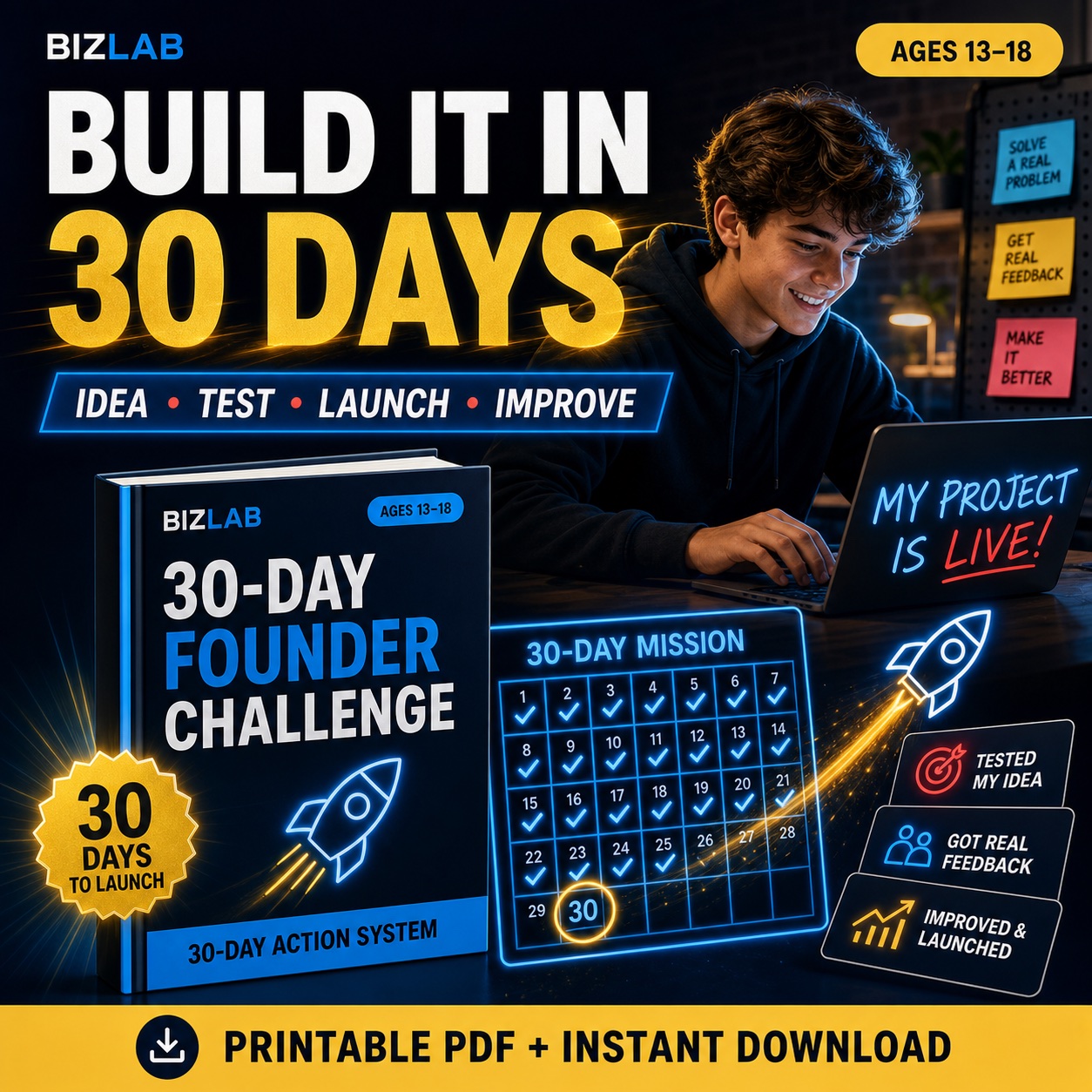
30-Day Teen Responsibility Challenge

30 daily prompts

Thirty small decisions that are genuinely theirs.

One short prompt a day, each requiring a decision and a follow-through. Built so responsibility is practised in small, survivable doses rather than announced as a rule.

  • A month of decisions the teen owned end to end
  • Evidence they can point to when their confidence dips
  • A lighter, more concrete way to talk about responsibility at home
Coming soonFor teens

First Business Idea Workbook for Teens

Printable workbook

From a vague thought to a testable idea.

A guided workbook that trains the Idea Muscle, then narrows the pile down to one idea small enough to test this month.

  • A repeatable way to produce ideas on demand
  • One idea shaped into a concrete offer
  • The smallest honest test of that idea, designed and scheduled
Coming soonFor teens

AI Skills for Teen Founders

Practical module

Argue with the machine. Keep the authorship.

How to brief AI properly, how to spot when it is confidently wrong, and how to use it to sharpen a plan while the thinking and the final wording stay the teenager's own.

  • Briefs that get useful answers instead of generic ones
  • A habit of verifying before using
  • A clear personal line between assistance and outsourcing

Built for minors

Safety is a design constraint, not a policy page.

Parent consent for under-16s

Members under 16 need a parent to confirm the account before they can post or interact. Until then the experience is read-only.

Illustrated avatars only

No real photographs as profile images. Members choose from an illustrated set.

No private messaging between members

Community conversation happens in moderated shared spaces. There are no member-to-member DMs.

Moderated by humans and AI

Posts, comments and submissions pass automated checks for personal data and harmful content, with a human moderation queue behind it.

Data handled under EU GDPR

BizLaboratory operates from the EU. Consents are recorded, and data can be exported or deleted on request.

Questions parents ask

Straight answers.

Does my teenager need a business idea to start?

No. Most start with nothing but curiosity. Generating and discarding ideas is part of the training — the Idea Muscle exercises exist precisely because 'I don't have an idea' is the normal starting point.

Is this about making my child rich?

No, and we would be careful with anyone who promises that. Entrepreneurship here is a learning environment: it is one of the few settings where a teenager can make a real decision, see a real consequence and adjust. Earning first money is a milestone, not the pitch.

How much time does it take?

It is self-paced. Lessons are short and end in a small action, so a teenager can move in short sessions around school rather than blocking out long evenings.

What is the parent's role?

Guide, not rescuer. You get the Conversation Bridge questions and enough context to ask the next useful thing instead of solving it for them. You do not need a business background.

How is AI used?

As a sparring partner. Teens use it to challenge assumptions, research faster and stress-test a plan — then verify it and write the final answer themselves. We never present AI as a replacement for their thinking.

Is it safe for a 12-year-old?

The community layer has parent confirmation for under-16s, illustrated avatars instead of photos, no private messaging between members, and moderated shared spaces.

What language is it in?

These pages and the global product line are in English. BizLaboratory also runs a full Slovak programme, including in-person academies — the SK switch in the menu takes you there.

Be first when the Academy opens.

One email when the English Academy launches, plus the occasional practical note for parents. Nothing else.

Launch updates only. Unsubscribe any time. Parents are welcome to sign up on a teenager's behalf.